
Guide
Single elimination, double elimination, round robin or Swiss: which tournament format fits your event?
How each tournament format on ESPODIUM works, how many matches it needs, and which one suits your teams, your schedule and your game.
By Lau Kah Hou6 min read
Pick single elimination when time is short, double elimination when you want a fairer champion, round robin when every team should play everyone, and Swiss when a solo field is too big for round robin. On ESPODIUM you can also chain these into stages, for example groups that feed a playoff bracket.
This guide explains each format as ESPODIUM runs it, how many matches it costs, and where you set it up.
The four formats on ESPODIUM
Every stage of a tournament uses one of four formats: Round Robin, Single Elimination, Double Elimination or Swiss. You pick one per stage under Tournament Stages when you create the tournament, and you can change the setup later in the Admin tab under Bracket & Stages.
Not every game offers every format. The setup screen only shows the structures your game and mode support, so a PUBG Mobile tournament sees lobby formats rather than a bracket, and a 1v1 game like eFootball sees the head-to-head options.
Single elimination
One loss and you are out. The winners of each match move on until one team is left.
Matches needed: one fewer than the number of entrants. A 16-team bracket is 15 matches. If you switch on Play a 3rd place match, add one more, played between the two semi-final losers.
Good for: one-day events, big open fields, and anything with a hard venue or stream slot.
The catch: one bad game ends a strong team's day, and every team except the champion plays only one or two matches. If your field is not a power of two (8, 16, 32), ESPODIUM fills the gaps with byes. The top seeds take the byes and those matches complete automatically.
Double elimination
Every team gets a second chance. Losing once drops you into the lower bracket; losing twice knocks you out. The upper and lower bracket winners meet in the grand final.
Matches needed: twice the number of teams, minus two. For 16 teams that is 30 matches. ESPODIUM plays the grand final as a single match, with no bracket reset, so the team coming from the lower bracket does not need to win it twice and the count never grows.
Good for: finals days and qualifiers where you want the best team to win, not the luckiest one.
The catch: it takes roughly twice as long, and the lower bracket runs behind the upper bracket, so plan your schedule around the slowest path. ESPODIUM offers two layouts, a standard one and an upper/lower split, which change how the bracket is drawn.
Round robin
Everyone in a group plays everyone else. Choose Single round robin (every team meets once) or Double round robin (every team meets twice, home and away).
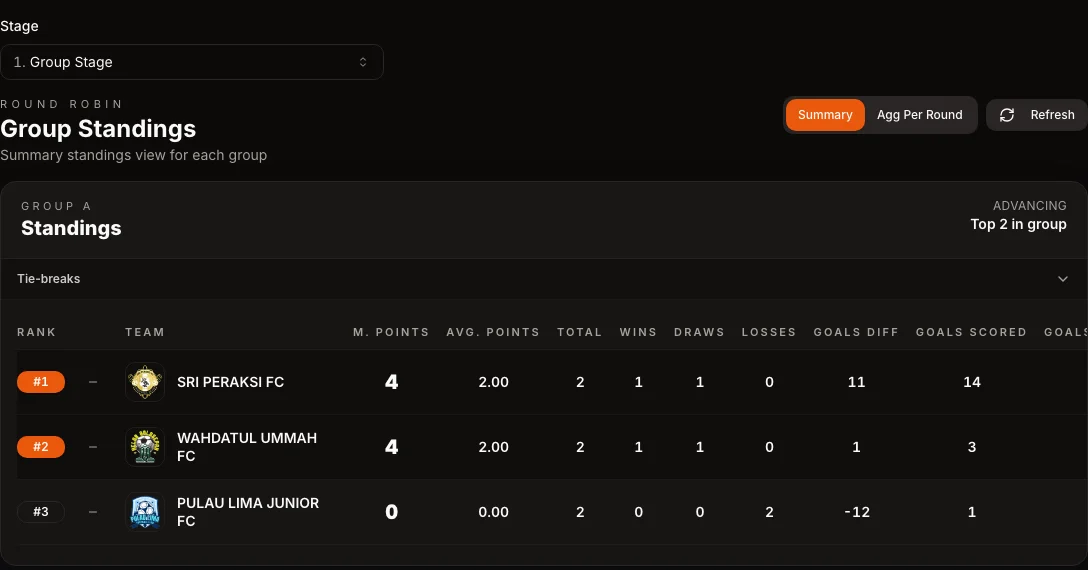
Round robin standings: match points first, then the tie-breakers you chose.
Matches needed: for a group of N teams, N × (N − 1) ÷ 2 matches in a single round robin. A group of 6 is 15 matches; a group of 8 is 28. Double round robin doubles that.
Good for: leagues, group stages, and small fields where you want lots of games for everyone.
How the table is decided: each result earns stage points. In best-of mode the defaults are 3 for a clean win, 2 for a close win, 1 for a close loss and 0 for a heavy loss. In fixed-games mode it is 3 for a win, 1 for a draw and 0 for a loss. You can change these, and you choose the order of tie-breakers under Team Standings Tie-break. The default order is Match Points, then Wins, then Clean Sweep Wins, then Head-to-head Wins, then Game Points.
The catch: match count grows fast. Split big fields into groups using Teams Per Group and Number of Groups, and let ESPODIUM generate the schedule automatically.
Swiss
In Swiss, nobody is knocked out early. Each round pairs players with similar records, so winners meet winners and the field sorts itself by skill over a few rounds.
On ESPODIUM, Swiss runs for solo tournaments in games that support it, such as Magic Chess: Go Go, and for team tournaments built from a Swiss template, such as the 16-team Swiss into a playoff. Once a round is finished, the organizer generates the next one from the bracket tab. In a team Swiss stage, teams on the same record meet, nobody plays the same team twice, an odd team out gets a bye, and the stage ends once every team has qualified or been knocked out.
Rounds needed: far fewer than round robin. Around five rounds are enough to rank 32 players, where round robin would need 496 matches.
Good for: large fields where round robin is impossible and single elimination feels too harsh.
The catch: the standings only settle once all rounds are played, and players need to understand that a loss in round one does not knock them out.
Side by side
| Format | Matches for 16 entrants | Minimum games per entrant | Best for |
|---|---|---|---|
| Single elimination | 15 (16 with a 3rd place match) | 1 | One-day events, big open fields |
| Double elimination | 30 | 2 | Qualifiers and finals where fairness matters |
| Round robin (one group) | 120 | 15 | Leagues and small groups |
| Swiss | about 5 rounds | 3 or more | Large fields, solo or team |
Combining formats into stages
Most serious events use more than one format. A common shape is a group stage in round robin followed by a single or double elimination playoff.
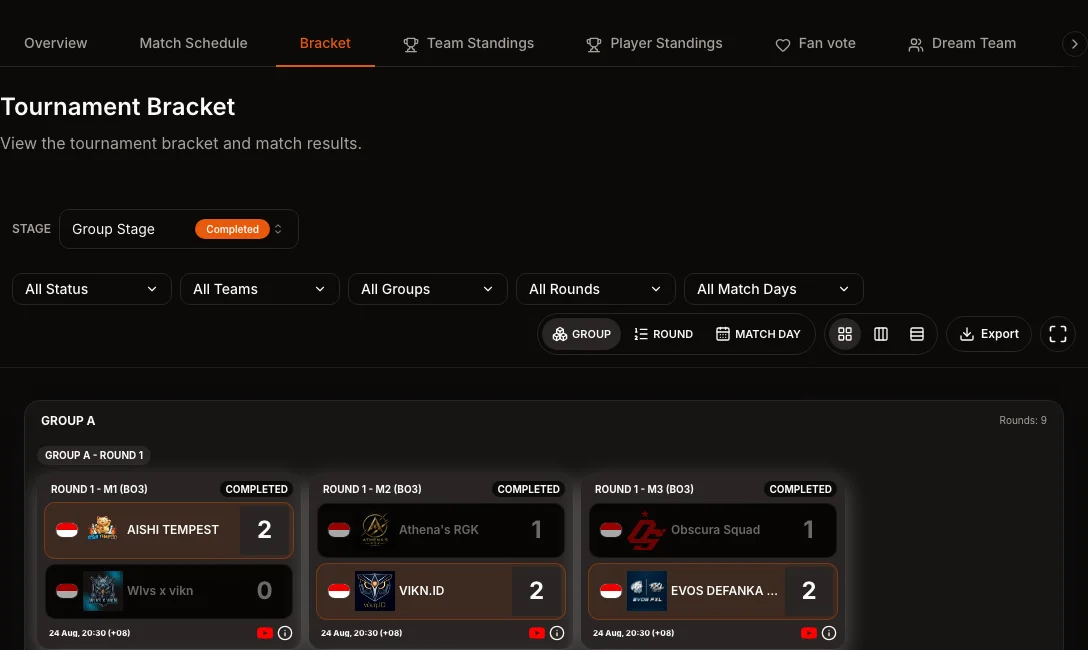
A group stage that feeds a playoff, shown round by round.
On ESPODIUM you add stages with Add Stage when creating the tournament, or later with Add stage in the admin tab. For each new stage you choose:
- Advancement rule: Top N Overall, Top N Per Group, or All Participants.
- Advance count: how many move on.
- Seeding method: Bracket Optimized, Group Winners Separated, Snake Seeding or Manual Seeding.
When the first stage finishes, the qualifiers move into the next one using those rules. ESPODIUM also ships ready-made templates for common shapes, such as group stages where the top four stagger into a single elimination bracket, or the top eight split between the upper and lower brackets of a double elimination playoff.
Lobby formats for battle royale and Magic Chess
Some games are not played head to head. PUBG Mobile is played in lobbies of up to 25 squads, and Magic Chess: Go Go solo is played in lobbies of 8. These use lobby formats instead of a classic bracket: points are awarded for placement (and for eliminations in PUBG), totalled across matches, and the top of each lobby moves on. We cover these in their own guides on running a PUBG Mobile tournament and on Magic Chess: Go Go rules.
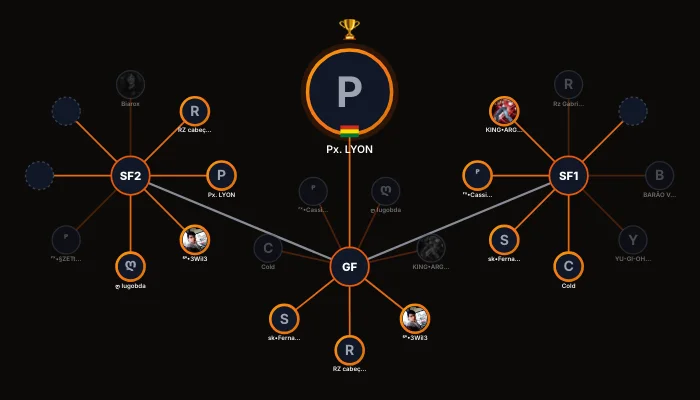
A lobby bracket: players advance by placement, not by beating one opponent.
Best of 1, best of 3 or more
Within any bracket format you also choose how many games make a match. Team brackets have a Default Format from Best of 1 to Best of 7, and you can override it per round, for example best of 1 early and best of 5 in the final. Solo brackets use Games Per Match instead.
A sensible default: best of 1 in early rounds of a large event, best of 3 from the quarter-finals, and best of 5 for the grand final if you have the time.
Next steps
- Count your entrants and your hours, then use the table above to see what fits.
- Create your tournament at Create a tournament and add a stage for each phase.
- Open Admin → Bracket & Stages to choose the template, best-of settings and seeding, then press Generate Bracket.
- New to hosting? Read how hosting works on ESPODIUM.
Written and checked by the ESPODIUM editor. How we write