
Guide
Magic Chess: Go Go tournament rules and formats explained
How Solo, Duo and Team Magic Chess: Go Go tournaments run on ESPODIUM, from lobby points and advancement to tie-breaks and result entry.
By Lau Kah Hou6 min read
Every Magic Chess: Go Go tournament on ESPODIUM is played in 8-player lobbies, and every placement from 1st to 8th earns points. What changes between formats is who those points belong to. In Solo they are yours, in Duo your pair ranks as one entrant, and in Team your four placements are added together against the other team's four.
This guide covers each mode, how points become standings, how players advance, how ties are broken and how results get entered.
The three modes
When an Organizer creates a Magic Chess tournament they pick one of three modes.
- Solo (FFA). Eight players per lobby, every player for themselves. Brackets come in sizes of 8, 16, 32, 64 or 128 players, and a stage needs at least 8.
- Duo. Four duos per lobby, so still 8 players. Each duo plays, ranks and advances as one entrant, like a team.
- Team. Two teams of 4 share one 8-player lobby: a 4v4 team battle. Brackets come in sizes of 4, 8, 16, 32 or 64 teams.
In Team mode the default line-up is 4 main players. Organizers can also allow substitutes, a coach and an analyst. A substitute who actually plays a game is scored on their recorded placement, just like a starter.
Placement points
Each lobby placement is worth a fixed number of points. The Organizer sets the table under Point System when creating the tournament, using a preset or their own values:
| Placement | Default 9-1 | 8-1 | 8-0 |
|---|---|---|---|
| 1st | 9 | 8 | 8 |
| 2nd | 7 | 7 | 6 |
| 3rd | 6 | 6 | 5 |
| 4th | 5 | 5 | 4 |
| 5th | 4 | 4 | 3 |
| 6th | 3 | 3 | 2 |
| 7th | 2 | 2 | 1 |
| 8th | 1 | 1 | 0 |
There is also a Custom option for any eight values. Always check which table your tournament uses before you play, because two events with the same format can score very differently. Under Default 9-1, 1st place is worth two points more than 2nd. Under 8-1, every step is worth one.
Magic Chess lobbies score placement only. Eliminations are recorded for battle royale games like PUBG Mobile, never for Magic Chess, and that includes Duo lobbies.
How a Team game is won
In a 4v4 game, each player's placement is turned into points, and each team's four scores are added up. The team with the higher total wins that game. A match is a series of these games, so a best-of-3 goes to the first team to win two.
For example, under Default 9-1, a team that finishes 1st, 3rd, 6th and 7th scores 9 + 6 + 3 + 2 = 20. The other team holds 2nd, 4th, 5th and 8th for 7 + 5 + 4 + 1 = 17. The first team wins 20-17, even though the other team had two players in the top four.
There is a useful property here. Under Default 9-1 and 8-0, the eight placements add up to an odd number (37 and 29), so a game cannot finish level. Under 8-1 they add up to 36, so an 18-18 game is possible.
How Solo and Duo lobbies advance
A Solo or Duo match is one lobby that plays a set number of games. The Organizer picks this under Games Per Match, from 1 to 7. Your placement points from every game in the match are added together, and the lobby is ranked on that total. Players level on points share a rank.
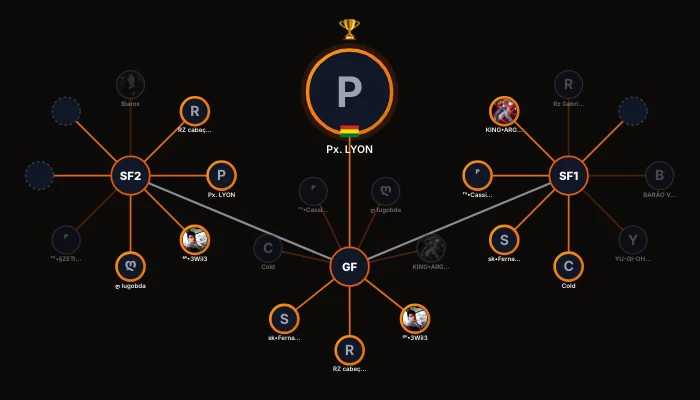
A finished Magic Chess Solo bracket: each lobby sends its top players on, up to the Grand Final.
In a Solo elimination bracket, the Organizer chooses how many from each lobby go through:
- Top 4. Half of each lobby advances. A 32-player bracket runs as four lobbies, then two, then one 8-player Grand Final.
- Top 2. A quarter of each lobby advances. This needs at least four 8-player lobbies, so the next round still fills a full lobby of 8. Four lobbies of 8 feed straight into one Grand Final.
If the player count does not fill whole lobbies, players are spread evenly rather than packed in. 25 players become lobbies of 7, 6, 6 and 6, not 8, 8, 8 and 1.
Solo lobby brackets can also be double elimination. Players who miss the cut in a winners' lobby drop to a losers' side and stay in the event. Missing the cut a second time knocks them out. The Grand Final is a full lobby of survivors from both sides. This needs Top 4 advancement.
For longer events, Organizers can use a multi-round lobby template instead. Points can carry over between rounds, and the field can be cut on the overall table rather than per lobby. The built-in Duo template, "32 duos → 24 → 8 (4 duos per lobby)", works like this:
- Round 1: eight lobbies of 4 duos, 3 games each. The top 3 duos in each lobby go through.
- Round 2: the 24 survivors are split into six new lobbies by their standing so far. After this round, only the top 8 duos on cumulative points remain.
- Final: the last 8 duos.
Templates can also give the final round a Checkmate Points rule (20 by default) in place of a fixed number of games.
How ties are broken
Standings tie-breaks can be set by the Organizer. If none are set, ESPODIUM uses a default order, so no tournament changes its ranking until someone chooses to.
Team Standings decide who advances from a group stage in Team mode. The Organizer sets the order in the stage setup under Team Standings Tie-break. The default order is Match Points, then Wins, Clean Sweep Wins, Head-to-head Wins and Game Points. Because advancement reads this table, changing the order changes who goes through, not just how the table looks.
Player Standings rank individual players across the whole tournament. The Organizer sets them from the Standings settings button on the Player Standings tab. For Magic Chess the choices are:
- Total Points
- Game Points
- #1 Finishes
- Average Rank (lowest)
- Top 3 Finishes
- Games Played (fewest)
- Last Game Rank (lowest) and Last Game Points, in lobby stages
- Team Match Points, Team Head-to-head Wins and #1 Finishes (Team Won), in Team mode
#1 Finishes (Team Won) counts games a player finished first in matches their team went on to win. Each rule can count every stage or only the stages you pick. For example, you could rank by #1 Finishes across the whole event, then fall back to Team Match Points from the group stage alone.
MVP and Average Performance are not offered for Magic Chess. Those figures are never recorded for it, so a rule built on them would tie everyone.
Commander Stats
Magic Chess tournaments get a Commander Stats tab that other games do not. It lists every commander picked in the event, with Total Picks, Pick Rate, Top 4 Rate and Win Rate. The figures come from the commander entered for each player in each game, so the tab is only as complete as the results entry.
How results are entered
Results are entered by the Organizer, or by crew they appoint, under Admin > Bracket & Stages. For each game in a match, they record:
- each player's placement, 1st to 8th
- each player's commander
The editor adds up the team totals as placements go in. The With game stats toggle should stay on for normal games. Switching to No game stats lets the Organizer just pick a winner, and the editor warns that this is only for punishments and forfeits. A game entered that way gives neither team any MMR.
Players can help. In the My Matches tab, each player sees the games they are scheduled in and can use Upload Screenshots to attach the end-of-game result screen, which gives the Organizer a record to enter from.
If the tournament is marked MMR Eligible, completed games also update each player's rating. See the MMR guide for how.
Checklist before your first Magic Chess event
- Check the mode: Solo, Duo or Team.
- Find out which points table is used. Default 9-1, 8-1 and 8-0 reward 1st place differently.
- In lobby brackets, check whether Top 4 or Top 2 advance, and how many games each match plays.
- Look for the MMR Eligible badge if your rating matters to you.
- Save your result screen after every game and upload it from My Matches.
- Find your next event on Magic Chess tournaments, or start one at Create Tournament.
Written and checked by the ESPODIUM editor. How we write