
Guide
How MMR works on ESPODIUM: solo, duo and team ratings explained
Where your ESPODIUM MMR comes from, what moves it after each game, when it appears on leaderboards, and what you can do to raise it.
By Lau Kah Hou6 min read
MMR on ESPODIUM is a rating that changes after each eligible tournament game you play. Everyone starts at 1,000. Your rating goes up or down depending on how you placed compared with what was expected from you against that lobby. It stays hidden on public pages until you have played 10 eligible games in that mode, and after that it puts you on the Players leaderboard for your game.
This guide walks through what counts, how one game changes your number, and what shows up where.
Three separate ratings: Solo, Duo and Team
You hold one rating per mode: Solo, Duo and Team. They are independent, so a strong week in solo lobbies does nothing to your team rating.
Which modes a game shows depends on the game:
- Magic Chess: Go Go shows Solo, Duo and Team.
- eFootball, EA FC and Tekken 8 are 1v1 games and show Solo only.
- Other games show Solo and Team.
Your rating belongs to you, not your team. If you change teams, you keep your team-mode MMR.
The rating is stored per mode, not per game. Leaderboards are filtered to the game you are browsing, but the number itself is your one rating for that mode.
Which games count
A game only moves your MMR when all of these are true:

MMR eligible tournaments carry a cyan MMR Eligible badge on their card.
- The tournament is marked MMR eligible. Look for the cyan MMR Eligible badge on the tournament card and the tournament page. Organizers cannot switch this on themselves; ESPODIUM admins set it per tournament.
- It is not a test tournament. A tournament in the Test category can never count toward MMR. The database rejects that combination.
- The match is completed. MMR is worked out when the organizer finishes the match, not while games are still being entered.
- The game has full results. In a solo lobby, all 8 players need a recorded placement, 1st to 8th, each different. In a team game, both teams need exactly 4 players with recorded stats, 8 players in total. A game that falls short is skipped.
In practice this means MMR moves in 8-player lobbies and 4v4 team games, which is how Magic Chess: Go Go is played. Formats with a different shape, such as 1v1 matches (eFootball, Tekken 8) or 5v5 team games, do not change MMR today, even in an MMR eligible tournament. Every game of a completed match is rated, not only the last one.
If an organizer records a team game with No game stats, which is meant only for punishments and forfeits, neither team gains or loses MMR for it. The match editor says this directly when you switch the toggle.
Duo MMR is not calculated yet. The Duo tab exists, but duo results do not move a rating today.
How one game changes your MMR
Behind the number shown on your profile is an internal skill estimate. Your MMR is that estimate converted to a friendlier scale that starts at 1,000. Each game updates it in four steps.
1. Expected result. Before the game, ESPODIUM compares your rating with the lobby's. In solo, that is you against the average of all 8 players. In team, it is your team's average against the other team's. Facing a stronger field lowers what is expected of you.
2. Actual result. In solo, your placement becomes a score: 1st counts as a full win, 8th as a full loss, and the places in between are spread evenly. In team, the team with more placement points wins the game. A bigger margin earns a better score, and the winners never score below a set floor.
3. Factors. The difference between actual and expected is then scaled:
- Placement or contribution. In solo, a higher placement earns more. In team, the top finisher on the winning side gains the most. On a loss this flips, so the player who did best on the losing side loses the least.
- Experience. In your first 10 games in a mode, changes are 15% larger. From your 11th to your 25th game they are 5% larger. After that they settle.
- Stage type. Games in single or double elimination stages move 5% more than group or league games.
- Rating gap within the game (team only). Lower-rated players in the game gain a little more on wins and lose a little less on losses.
4. Caps. Every game has a hard cap, so one result can never swing your rating wildly. In solo, it works out at about 160 MMR for a single game; team games are capped lower.
What a solo game does to a new player
For a new player in a lobby of new players, a top-half finish gains MMR and a bottom-half finish loses it. 1st gains the most, and the drop for 8th is smaller than the gain for 1st, so one bad game costs you less than one win earns you.
Team games: why teammates move by different amounts
In a team game every player on the winning side usually goes up, but not by the same amount. The player who placed highest in the lobby gains the most. On a team that was expected to win easily, players who finished near the bottom of the lobby can have their gain trimmed almost to nothing.
There is also a reward for a close loss. If your team loses by 3 points or fewer and you personally finished in the top 4, you gain a small amount instead of losing.
When your MMR becomes visible
Until you have played 10 eligible games in a mode, that mode's MMR shows as a dash on public pages and you are left off the leaderboard. This is the provisional period. Your rating is still being calculated in the background, and early games move it faster so it reaches your level sooner.
What counts is that the tournament is MMR eligible, whatever its category.
Where MMR shows up
- Players leaderboard. Open Players for your game and pick Solo, Duo or Team. You can filter by country and search by name. Arrows show how far each player has moved since before their most recent match. To appear, you need 10 or more games in that mode, at least one MMR event in that game's tournaments, and a game profile for that game.
- Your player profile. Each mode shows your MMR and number of games. The Match History card has a chart of your rating game by game, and each entry shows the points won or lost.
- Account, Match activity. Your own match cards show the MMR change for each match.
- Teams directory. Teams list a Total MMR and an Avg MMR. Both count only active members who have 10 or more team-mode games, using their team MMR. Total MMR is the default sort.
- Home page. The Top 10 Players board ranks by team MMR.
- Elsewhere. MMR also orders fan vote ballots, and it feeds the Talents ranking, Dream Team and your CV.
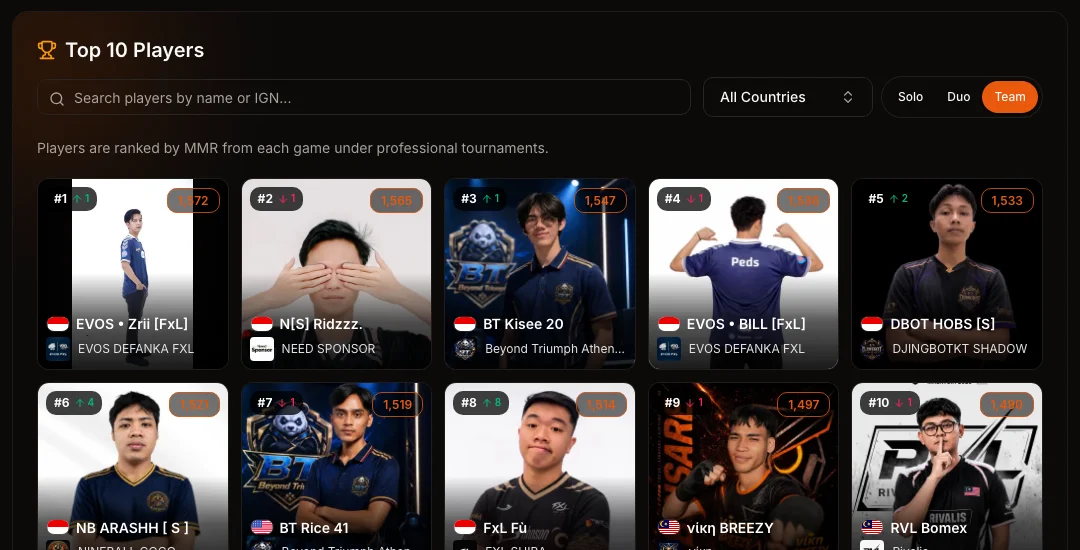
The Players page ranks players by MMR, with Solo, Duo and Team views and a country filter.
How to raise your MMR
- Enter MMR-eligible tournaments. Check for the MMR Eligible badge before you register. Nothing else counts.
- Keep your game profile. The leaderboard only lists players with a game profile for that game.
- Aim for the top half of the lobby. In solo, finishing 4th and finishing 5th are the difference between a small gain and a small loss.
- Beat stronger lobbies. Wins against a higher-rated field are worth more, and expected wins against weaker players are worth little.
- Carry your share in team games. Your own placement inside the team decides how much of the team's result you get, in both directions.
- Ask organizers for complete results. A game without all 8 placements, or entered as No game stats, does not count. If something looks wrong, your organizer can correct it.
Next steps
- Read the short reference version on MMR Calculation.
- Find MMR-eligible events on Magic Chess tournaments.
- See where you stand on the Players leaderboard.
Written and checked by the ESPODIUM editor. How we write